


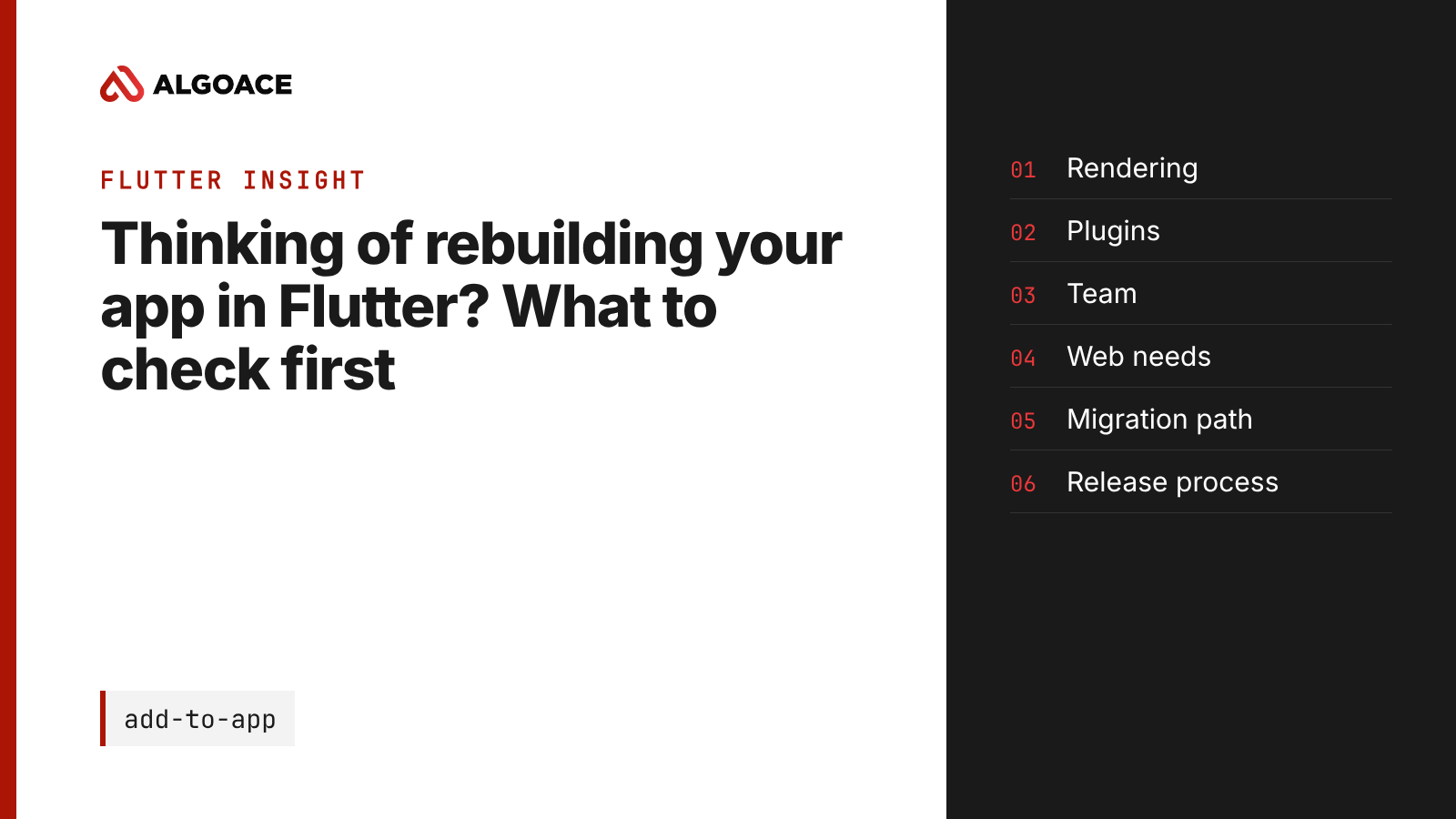
Rebuild in Flutter when two separate native apps cost you double on every feature, your design depends on a custom interface, and your key SDKs have maintained Flutter plugins. Before a full rewrite, check plugin coverage, team skills, web needs, and whether Flutter's add-to-app lets you migrate screen by screen instead.
A rewrite is the most expensive decision a product team makes after launch. Users get nothing new while it happens, and the old app still needs fixes. Flutter is a strong framework for the right product. It is a poor reason on its own to stop shipping for six months.
These are the six checks we run with founders before recommending a Flutter rebuild.
Why do teams move existing apps to Flutter?
Teams move to Flutter to replace two native codebases with one Dart codebase, to get identical custom UI on iOS and Android, and to ship features once instead of twice. The case is strongest when the iOS and Android apps have drifted apart and every release means two implementations, two QA passes and two sets of bugs.
The weak reasons we hear: "Flutter is faster" with no measurement behind it, a new hire who prefers Dart, or a hope that a rewrite will fix product problems. A rewrite fixes code structure. It does not fix an unclear product.
Check 1: Does your app suit Flutter's rendering model?
Flutter draws its own interface with its own rendering engine instead of using platform UI components. Impeller is the only supported renderer on iOS and the default on Android API 29 and above. That suits branded, animation-heavy interfaces. Apps that must look exactly like system apps need extra work to match platform conventions.
This is Flutter's main strength and its main trade-off. Your design system renders identically on both platforms, and complex animation is first-class. In return, platform behavior such as text selection, accessibility and navigation conventions is reproduced by Flutter rather than inherited, so it needs testing on real devices for each platform.
Check 2: Do your critical SDKs have maintained Flutter plugins?
List every third-party SDK your app uses: payments, analytics, attribution, maps, chat, video and authentication. For each one, confirm an official or actively maintained Flutter plugin exists on pub.dev and supports the features you use. Any gap means writing and maintaining a platform channel to native code yourself.
This check kills more rewrites than any other. Attribution and analytics SDKs often ship features to their native and React Native SDKs first. A plugin that exists but lags the native SDK by a major version will cost you later. Platform channels are well documented and work, but each one is native code you now maintain in Swift or Kotlin and in Dart.
Check 3: Who will maintain a Dart codebase?
Flutter apps are written in Dart, which most web teams do not use. If your company's engineers write TypeScript, a Flutter app becomes a separate skill silo. Budget for Flutter engineers, or for training, and keep native iOS and Android knowledge for platform channels, store releases and OS changes.
The hiring market matters as much as the framework. Check how many Flutter engineers you can realistically hire in your timezone at your level, and who covers the app when one of them leaves.
Check 4: Do you also need a web app?
Flutter can build for the web, but it renders to a canvas rather than standard HTML. That works for app-like tools behind a login. It is a poor fit for public pages that must be indexed by search engines and cited by AI answers. Plan a separate web frontend if search traffic matters.
If your web product is a marketing site plus a dashboard, the common pattern is a framework like Next.js for public pages and either Flutter web or a React app for the dashboard. Decide this before the rebuild, because it changes how much code you can share.
Check 5: Can you migrate screen by screen instead of rewriting?
Answer: Usually yes. Flutter's add-to-app feature embeds Flutter screens inside an existing iOS or Android app. You can build new features in Flutter, move high-change screens next, and keep stable native screens until they need work. Users keep getting updates during the migration.
Approach | When it fits | Main risk |
|---|---|---|
Full rewrite in Flutter | Small app, or native code too tangled to keep | Months without new features, two apps to fix meanwhile |
Add-to-app, screen by screen | Large app with active users and a release schedule | Two stacks in one app during the transition |
Stay native, fix the process | Apps that differ by design, or a team without Dart | Feature work stays doubled |
Move to React Native instead | Company already writes TypeScript and has a web app | Same migration effort, different skill set |
Add-to-app has costs: two build systems in one app, a larger binary during the transition, and navigation between native and Flutter screens to design carefully. For most live apps, those costs are smaller than a release freeze.
Check 6: Is your release process ready for one codebase?
One codebase means one release train for both stores. Set up automated builds and signing for iOS and Android, a staged rollout on each store, crash reporting tagged by release, and device tests on both platforms before you move users. Without this, a shared codebase ships a shared bug to everyone at once.
Flutter's stable channel releases several times a year; the current stable release is Flutter 3.47, from August 2026. Pin your Flutter version, upgrade on a schedule, and read the breaking changes page before each upgrade. We describe how we build in Flutter on our Flutter page.
So should you rebuild in Flutter?
Rebuild in Flutter if at least four of the six checks come out in its favor: a custom interface, plugin coverage, a team that can own Dart, no indexed web needs inside the app, a migration path, and a release process ready for one codebase. If fewer pass, fix the process around your native apps first.
The right answer is often "not yet": add-to-app for new features this quarter, a full decision once you have run Flutter in production on a few screens. That turns a large bet into a small, reversible one.
Weighing a Flutter rebuild? Book a scoping call and we will run these six checks against your app and SDK list. Our mobile app engineering team builds in Flutter, React Native and native, so the recommendation follows your product. You are never handed to a junior or a subcontractor. Your product is yours, completely.
Sources
- Flutter docs, Impeller rendering engine (platform defaults): https://docs.flutter.dev/perf/impeller
- Flutter docs, What's new (Flutter 3.47, 12 August 2026): https://docs.flutter.dev/release/whats-new
- Flutter docs, Add Flutter to an existing app: https://docs.flutter.dev/add-to-app
- Flutter docs, Writing custom platform-specific code (platform channels): https://docs.flutter.dev/platform-integration/platform-channels
- Flutter docs, Web renderers: https://docs.flutter.dev/platform-integration/web/renderers
- Flutter docs, Breaking changes: https://docs.flutter.dev/release/breaking-changes
Questions this raises
Is Flutter good for production apps in 2026?
Yes. Flutter 3.47 is the current stable release as of October 2026, and Impeller is the only supported renderer on iOS and the default on Android API 29 and above. Production quality depends on plugin coverage for your SDKs, device testing on both platforms and a disciplined release process.
Can I migrate a native app to Flutter gradually?
Yes. Flutter's add-to-app feature lets you embed Flutter screens or modules in an existing iOS or Android app. Teams typically build new features in Flutter first, then move frequently changed screens, and leave stable native screens until they need work.
Is Flutter or React Native better for a rebuild?
It depends on your team and product. Flutter suits custom, animation-heavy interfaces and teams willing to work in Dart. React Native suits companies that already write TypeScript and want to share code with a web app. Both support gradual migration from native apps.
Can a Flutter app also be my website?
Flutter web works well for app-like tools behind a login. It renders to a canvas, so it is not a good fit for public pages that need search engine indexing. Most teams pair a Flutter app with a separate web framework for marketing pages.
What is the biggest risk in a Flutter rewrite?
Missing or outdated plugins for critical SDKs, discovered halfway through. Audit every third-party SDK before committing, and budget for platform channels where official Flutter support is missing or behind the native SDK.